The goal was to create an exam review that needed to be completed on a white t-shirt and could be worn for extra credit
Friday, November 12, 2010
Monday, November 1, 2010
Face Paint Math
Here's an idea for some giggly fun. Each student is given one problem that they must solve using facepaint on their partner. They must solve it correctly or their partner will be walking around with the wrong solution on their face all day. Friday, October 29, 2010
Teaching Negatives By Playing War
Things You'll Need:
Playing Cards
Two Player Directions For Normal Play
1. Shuffle a deck of playing cards.
2. Deal cards face down so that each player ends up with the same number of cards.
3.Put your cards in a stack face down without peeking at them.
4.Turn up your top card and place it in the center of the table. Be sure the other player does this at the same time you do.
5. See who has the higher card. The ace is highest, followed by the king, queen, jack, 10, 9, 8, 7, 6, 5, 4, 3 and, finally, the 2.
6. See if there is "war" ' that is, see if both cards on the table are the same, such as two jacks or two 3s.
7. If there is war, place your top card from your stack of cards face down on the turned-up card. Be sure the other player does this at the same time and without looking at the face-down card.
8. Turn up the next top card from your stack at the same time the other player does.
9. See who has the higher card.
10. Take all the cards from the center of the table if you had the higher card. Put these cards in a pile separate from your stack of cards. Give up your card or cards if you had the lower card.
11. Turn up the next top card from your stack of cards and place it in the center of the table when the other player does the same.
12. See who has the higher card, or if there is war. Take the cards if you end up with the higher card. Give up your card if yours is lower.
13. Turn over your cards one at a time until your stack is used up. Then use the pile of cards that you won as your stack and make a new pile for the cards you win.
14. Continue playing until one player has all the cards.
Two Player Directions For Negative Numbers.
Make the red cards negative and the black cards positive.
Wednesday, October 27, 2010
Fun With Factoring
Here are some fun problems with factoring out greatest common factor
1) gi + pgee + fgunny
g(i + pee + funny)
2) c3p + c3o
c3(p + o) (from starwars)
3) te + pthone^2 + htome^2
et( 1 + phone + home)
I have a lot more that i will put into a word document so you can download.
Tuesday, October 26, 2010
Hunting For Treasure
When teaching graphing i like to talk about hunting for treasure

Before teaching the x-axis and y-axis and where to plot point (2,2), it may be beneficial to go on a treasure hunt outside.

For example, create a system of walk straight for 10 steps, turn left and walk 5 steps, turn straight and walk 2 steps, etc, at which point the student will discover some burried treasure. This could be used as a gate way into how important it is to follow directions

Before teaching the x-axis and y-axis and where to plot point (2,2), it may be beneficial to go on a treasure hunt outside.

For example, create a system of walk straight for 10 steps, turn left and walk 5 steps, turn straight and walk 2 steps, etc, at which point the student will discover some burried treasure. This could be used as a gate way into how important it is to follow directions
Monday, October 25, 2010
Box Paper Variation Warm Up
Box paper was used by students to show their work. I like using it to keep track of warm ups. The box paper below can be used for warmups while also adding additional work for those who finish early.
Sunday, October 24, 2010
Multiplying Integers Using an Alternative Game of Tic-Tac-Toe
Content/concept(s) to be covered:
The purpose of this lesson is to teach the fundamental properties of integer multiplication. Students will use their knowledge of negative and positive integers in an attempt to beat their opponent at a game of tic-tac-toe variation using plus symbols and minus symbols to represent negative and positive numbers.
Instructional objectives:
The objective for each student is, via the process of competition with other students, to recognize the difference in multiplication of negative numbers with other negative numbers as well as negative numbers with positive numbers. At the end of this lesson students should remember that a negative number multiplied by a negative number always yields a positive number. Likewise, at the end of this lesson, the students should remember that a negative number multiplied by a positive number should yield a negative number. The game will involve the use of plus and minus symbols (vs. x and o) on a regular tic-tac-toe board. Each student will have an opponent, the winner of the game ventures onward toward other winners in a game of single elimination. The winner of the all student-to-student games must face the teacher in the finals.
Materials needed for the activities:
• Two different colored markers
• Regular tic-tac-toe worksheet (can be created by students or printed)
• Tally sheet to keep track of eliminated players
Introduction or introductory activity:
1) The educator must begin the lesson with a background of integers and how they differ from counting numbers. Furthermore, the educator should draw a number line labeling zero in order to highlight the difference between a negative number and a positive number.
2) Next, the educator should review the differences between multiplying positive and negative integers by explanation as well as by placing an easy to follow diagram on the overhead or whiteboard
3) Next, the educator should review the game tic-tac-toe in its traditional form by explaining the rules of the game and playing a practice round with a volunteer student
4) Finally, the educator should explain the way the game will be played with its integer variation of positive and negative symbols (Explained more fully below)
Instructional activities:
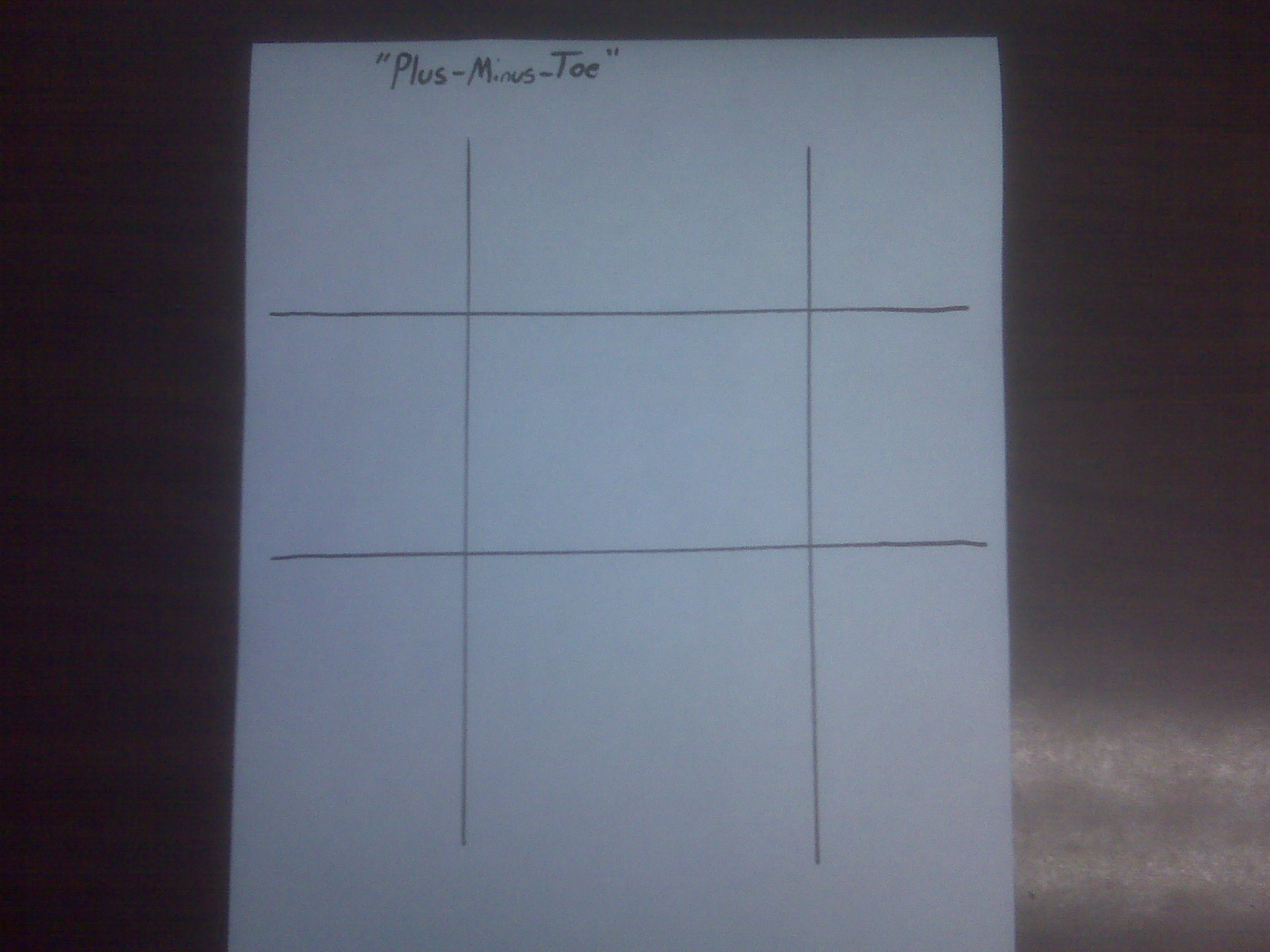
1) The game is played with the traditional tic-tac-toe board (shown below) but with + and – symbols instead of X and O symbols. The + symbol represents a positive number while the – symbol represents a negative number
2) Before the game is begun have each player decide whom will be the + symbol and whom will be the – symbol.
3) Next, have each student choose a square that they will label theirs, placing negative symbols or positive symbols around the square (shown below).
4) Explain that any symbol placed in either of these two squares must be multiplied by the symbol already in the square. Thus, if a + symbol is placed in the square surrounded by plus symbols then the ultimate symbol will be a plus symbols (since + times a + = +). However, if a negative symbol is placed in the square surrounded by plus symbols then the ultimate symbol will be a negative (since + times a – = –)
5) Explain to the students that they may ultimately think of choosing a square as placing a trap for their opponent
6) Next, have the student play the game as if they were playing a traditional tic-tac-toe game (shown below)
The purpose of this lesson is to teach the fundamental properties of integer multiplication. Students will use their knowledge of negative and positive integers in an attempt to beat their opponent at a game of tic-tac-toe variation using plus symbols and minus symbols to represent negative and positive numbers.
Instructional objectives:
The objective for each student is, via the process of competition with other students, to recognize the difference in multiplication of negative numbers with other negative numbers as well as negative numbers with positive numbers. At the end of this lesson students should remember that a negative number multiplied by a negative number always yields a positive number. Likewise, at the end of this lesson, the students should remember that a negative number multiplied by a positive number should yield a negative number. The game will involve the use of plus and minus symbols (vs. x and o) on a regular tic-tac-toe board. Each student will have an opponent, the winner of the game ventures onward toward other winners in a game of single elimination. The winner of the all student-to-student games must face the teacher in the finals.
Materials needed for the activities:
• Two different colored markers
• Regular tic-tac-toe worksheet (can be created by students or printed)
• Tally sheet to keep track of eliminated players
Introduction or introductory activity:
1) The educator must begin the lesson with a background of integers and how they differ from counting numbers. Furthermore, the educator should draw a number line labeling zero in order to highlight the difference between a negative number and a positive number.
2) Next, the educator should review the differences between multiplying positive and negative integers by explanation as well as by placing an easy to follow diagram on the overhead or whiteboard
+ = Positive numbers - = Negative numbers
+ times a + = +
+ times a - = -
- times a - = +
- times a + = -
3) Next, the educator should review the game tic-tac-toe in its traditional form by explaining the rules of the game and playing a practice round with a volunteer student
4) Finally, the educator should explain the way the game will be played with its integer variation of positive and negative symbols (Explained more fully below)
Instructional activities:
1) The game is played with the traditional tic-tac-toe board (shown below) but with + and – symbols instead of X and O symbols. The + symbol represents a positive number while the – symbol represents a negative number
2) Before the game is begun have each player decide whom will be the + symbol and whom will be the – symbol.
3) Next, have each student choose a square that they will label theirs, placing negative symbols or positive symbols around the square (shown below).
4) Explain that any symbol placed in either of these two squares must be multiplied by the symbol already in the square. Thus, if a + symbol is placed in the square surrounded by plus symbols then the ultimate symbol will be a plus symbols (since + times a + = +). However, if a negative symbol is placed in the square surrounded by plus symbols then the ultimate symbol will be a negative (since + times a – = –)
5) Explain to the students that they may ultimately think of choosing a square as placing a trap for their opponent
6) Next, have the student play the game as if they were playing a traditional tic-tac-toe game (shown below)
7) In the scenario above the player using the – symbol believes they are about to win the game by placing their symbol in the upper left-hand corner. However, when they do, they realize that a negative multiplied by a negative numbers is actually a positive number (and thus they fell into their own trap)
8) Ultimately, this game continues without a winner and must be replayed.
Friday, October 22, 2010
Thursday, October 21, 2010
From Fractions To Division
Many students know how to divide, but they forget how to transition from a fraction to division. Thus, given the fraction 3/10 they may ask is it 3 divided into 10 or 10 divided into 3. Here is a picture to help them remember
Wednesday, October 20, 2010
Showing Your Work With Just Your Finger
The point of this lesson is for students to show their work without really showing their work. Thus, they will be given a problem and using only their finger they must walk their partner (and eventually you) through the solution using only their finger. My mic seems to be messed up, but here is a video
Tuesday, October 19, 2010
Song Lyrics and Proportions
Here was a popular song a few years back, JORDIN SPARKS - "Battlefield". Personally, the song drove me crazy given the amount of times she says "battlefield". Thus, i posed the question, how many times would she say "battlefield" if the song was 10 minutes vs. 4.01 minutes. HERE's WHERE PROPRTIONS CAN HELP US.
First have your students read the lyrics recording how many times she say the word "battlefield". Next, give the length of the song in minutes or seconds and pose the questions how many times would she say "battlefield" if the song was 10 minutes long". Print off the worksheet below.
Don't try to explain your mind
I know what's happening here
One minute, it's love
And, suddenly, it's like a battlefield
One word turns into a
Why is it the smallest things that tear us down
My world's nothing when you're gone
I'm out here without a shield - can't go back, now
Both hands tied behind my back for nothing, oh, no
These times when we climb so fast to fall, again
Why we gotta fall for it, now...
Chorus:
I never meant to start a war
You know, I never wanna hurt you
Don't even know we're fighting for
Why does love always feel like a battlefield, a battlefield, a battlefield
Why does love always feel like
Can't swallow our pride
Neither of us wanna raise that flag, mmm
If we can't surrender
Then, we're both gonna lose we have, oh, no
Both hands tied behind my back for nothing (nothing), oh, no
These times when we climb so fast to fall, again
I don't wanna fall for it, now...
I never meant to start a war
You know, I never wanna hurt you
Don't even know we're fighting for
Why does love always feel like a battlefield, a battlefield, a battlefield
Better go and get your armor (get your armor), get your armor (get your armor)
I guess you better go and get your armor (get your armor), get your armor (get your armor)
I guess you better go and get your
We could pretend that we are friends, tonight (oh)
And, in the morning, we wake up, and we'd be alright
'Cause, baby, we don't have to fight
And I don't want this love to feel like a battlefield, a battlefield, a battlefield
Why does love always feel like a battlefield, a battlefield, a battlefield
I guess you better go and get your armor...
I never meant to start a war
You know, I never wanna hurt you
Don't even know we're fighting for
Why does love always feel like a battlefield, a battlefield, a battlefield
I guess you better go and get your armor (get your armor), get your armor (get your armor)
Why does love always feel like (oh, oh)
Why does love always feel like a battlefield, a battlefield
I never meant to start a war
Don't even know what we're fighting for
I never meant to start a war
Don't even know what we're fighting for
Monday, October 18, 2010
The House of Quadrilaterals
When teaching polygons or quadrilaterials it might be beneficial to have your students become an architect and build a house with each type of shape (it would look something like the picture below, but more complex)
Saturday, October 16, 2010
Playing Quadrilateral's With Isometricdots. This Game Rocks! (Now With Workbook)
If you need to teach your students the differences between quadrilateral's here is an awesome game that they probably already know how to play. Most students have used isomerticdot paper (click here) to play squares (The game where you draw lines till one person forms a square and then label it their square). Why not use the same concept to play quadrilateral's?
The point of the game is to continue to connect dots with lines until a quadrilateral is formed, see below. After a quadrilateral is formed have the students label it and they get the points. Whoever has the most shapes at the end wins
Click here
Friday, October 15, 2010
Four Corner Texting
Your school probably has rules about cell phone use, so this exercise may be best completed by administration permission or outside. Nevertheless, the way i conducted the activity was to place students in four groups
Next, give each group a multiple step problem like 10x + 6 = 16 and have each group do a certain portion of the problem, then text the remaining portion to the other group who will do another step and text the remaining portion to the next group and so forth.
Thursday, October 14, 2010
Twilight Math 1: Run Edward Run!
Edward is the fastest Cullen, but he must travel 1200 miles to reach Bella before she is hurt by the tracker James. If Edward arrived to Bella in 2.2 hours, how fast can Edward travel?
Based on the movie, the other Cullens arrived within a few minutes after Edward. Thus, how fast would you assume the average vampire can run?
Wednesday, October 13, 2010
Vertical Angle Show-and-Tell
Send your students home with the project of finding something with vertical angles, next day have them show-and-tell what makes the angles vertical versus complementary or supplementary, etc. Say theres a prize for the best vertical angle
Here is an idea you might get--The X-Box Symbol
Tuesday, October 12, 2010
Extrapolating Data For Fingernail Growth
A fun experiment that can teach proportions, among numerous things, is calculating the growth rate of your student’s fingernails over the course of the year using data from one week.
Monday: Have your students measure their thumbnail from root to tip (or other fingers, but beware of the one they will likely pick :) with as accurate of a measuring device as you have access to. Have the students record their information on some type of lab sheet or worksheet. Between now and then you might want to have your students ask their science teacher what fingernails are made of and why they grow.
**Note, this is a great exercise to start off the class on Monday's when everyone is sleepy and cranky**
The following Monday have your students re-measure their fingernail and calculate the growth as accurately as possible. Next, have your students contemplate how they would use this data to figure out how long their fingernails will be in 6 months, 1 year, 5 years, 10 years, and 100years (you may want to provide them with an equation or a proportion)
Finally, use the picture below and ask your students to estimate, based on their data, how long it took this women to let her fingernails grow
Monday: Have your students measure their thumbnail from root to tip (or other fingers, but beware of the one they will likely pick :) with as accurate of a measuring device as you have access to. Have the students record their information on some type of lab sheet or worksheet. Between now and then you might want to have your students ask their science teacher what fingernails are made of and why they grow.
**Note, this is a great exercise to start off the class on Monday's when everyone is sleepy and cranky**
The following Monday have your students re-measure their fingernail and calculate the growth as accurately as possible. Next, have your students contemplate how they would use this data to figure out how long their fingernails will be in 6 months, 1 year, 5 years, 10 years, and 100years (you may want to provide them with an equation or a proportion)
Finally, use the picture below and ask your students to estimate, based on their data, how long it took this women to let her fingernails grow
Monday, October 11, 2010
Using Hats To Teach Order of Operations
On the military rankings for order of operations theme i thought of a great idea. Split your students into groups and have each group make a different order of operation hat.
Thus, you should have six hats with each of these
( )
x^2
x
/
+
-
Now, have four volunteers pick four of the hats to put on and pick one volunteer to be your example. The goal of this exercise is for students to follow directions in the right order, thus they should follow the advice of the student wearing the parenthesis hat before the student wearing the multiplication hat.
Thus, give each of the four students with the hats on, four different sets of directions. Have them each give their directions to your volunteer student and see of the student follows them within the correct order of operation.
Thus, you should have six hats with each of these
( )
x^2
x
/
+
-
Now, have four volunteers pick four of the hats to put on and pick one volunteer to be your example. The goal of this exercise is for students to follow directions in the right order, thus they should follow the advice of the student wearing the parenthesis hat before the student wearing the multiplication hat.
Thus, give each of the four students with the hats on, four different sets of directions. Have them each give their directions to your volunteer student and see of the student follows them within the correct order of operation.
Saturday, October 9, 2010
Assign your Order of Operations Military Rank
The please excuse my dear aunt sally is a great learning tool for memorizing order of operations but I think I got a better tool-- Military Rank
Parenthesis: The General
Exponents: The Colonel
Multiplication/Division: The Sergeant
Addition/Subtraction: The Private
A great activity would be for you to have your students draw each soldier and label them Parenthesis: The General, Exponents: The Colonel, Multiplication/Division: The Sergeant and Addition/Subtraction: The Private.
Now take this problem as an example:
(4 + 3) + 2^2 x 6 and ask what is the generals command? What is the Colonels command? What is the Sergeants command? Wha is the Privates order?
Friday, October 8, 2010
A Trick For Multiplying Integers
Let a penny represent a positive number
Let a nickel represent a negative number
Thus a penny multiplied by a penny is a penny (likewise a positive times a positive is a positive)
Thus a penny multiplied by a nickel is a nickel (likewise a positive times a negative is a negative)
This little trick doesn't work with nickels multiplied by nickels
Let a nickel represent a negative number
Thus a penny multiplied by a penny is a penny (likewise a positive times a positive is a positive)
Thus a penny multiplied by a nickel is a nickel (likewise a positive times a negative is a negative)
This little trick doesn't work with nickels multiplied by nickels
Thursday, October 7, 2010
Distinguishing Between Complementary and Supplementary Angles
This is my favorite way of distinguishing between complementary and supplementary angles. First, we know that complementary angles are two angles whose sum is 90 degrees. Likewise, supplementary angles are two angles whose sum is 180 degrees.
First ask what name comes to mind when you hear the word complementary…complement. Ask who can you give a complement to? Can you give a complement to your grandmother on her 90th birthday? What about on her 180th birthday?
Perfect! So, you can only give complements to 90 year old grandmothers, thus, complementary angles can only by 90 degree angles.
Wednesday, October 6, 2010
When teaching decimals conversions: “W” or the “butt cheek” method?
I personally like the butt cheek method. Nevertheless, a good way to pratice this is to actually cutout a upper case W or a Butt Cheek and have the students place them on the decomals to percentage problems
Tuesday, October 5, 2010
John Nashing Your Classroom Windows
If you have never seen the movie "a Beautiful Mind" or read the bio the movie was based off of, i suggest you remedy that. It's very good! In the movie you can see the mind of the genius working at his window
Switch up the routine a little and use your classroom windows for math. All you need are some markers
And some problems (notice i tried to block the sun shining through your window with paper in order to take the pic)
Switch up the routine a little and use your classroom windows for math. All you need are some markers
And some problems (notice i tried to block the sun shining through your window with paper in order to take the pic)
Sunday, October 3, 2010
Please Float These Ideas Around
I know when i first started teaching i would seclude my ideas from the rest of the staff because i wanted credit for them. I remember observing a classroom doing an awesome activity, when i mentioned borrowing it to the teacher i was given a hesitant look. Conceited us! If only we could share : )
Saturday, October 2, 2010
Teaching Dividing By Zero versus Into Zero
We know that,
0/2 = 0
BUT
2/0 = undefined
Now, how do we teach it?
The trick is to use a rubber band :)
Now ask the students to pretend they are using zero to push on an object. Then ask, how the heck could you push something with nothing? Remeber, the roberband is supposed to be zero but how can zero of something (nothing) push something (the pen)?
We know that,
0/2 = 0
BUT
2/0 = undefined
Now, how do we teach it?
The trick is to use a rubber band :)
Place a rubber band on each of your student’s desks and have them make a zero out of it
Now place a heavy object like a pen or pencil above it with the
Now ask the students to pretend they are using zero to push on an object. Then ask, how the heck could you push something with nothing? Remeber, the roberband is supposed to be zero but how can zero of something (nothing) push something (the pen)?
Cleanliness and Mathematics
Two major issues in the public school system is cleanliness and learning math. How about we solve both at one time?
First you need two hand sanitizer bottles of different 3D forms like so,
The goal is to estimate the volume by number of hand washes. First measure the amount used per single hand wash (you wash your hands while the class watches) then take turns. Next, have tally sheet posted on the wall near the hand sanitizer. Once the final squirt is complete, have the students tally up its volume. Continue this throughout the year with various shapes and sizes of hand wash or hand sanitizer.
First you need two hand sanitizer bottles of different 3D forms like so,
The goal is to estimate the volume by number of hand washes. First measure the amount used per single hand wash (you wash your hands while the class watches) then take turns. Next, have tally sheet posted on the wall near the hand sanitizer. Once the final squirt is complete, have the students tally up its volume. Continue this throughout the year with various shapes and sizes of hand wash or hand sanitizer.
Friday, October 1, 2010
Sunday, August 29, 2010
The Human Clock OR The Human x-y Coordinate
The clock would be great for teaching young people how to tell time, but why stop there. Why not create a human x-y coordinate system
Playground Math
Why should other subjects recieve a monopoly on fieldtrips? Take your students to the playground outside your school or within the nearest park and teach them math
Your local playground offers so much in terms of teaching mathematics. It simply takes some thought. Some examples,
The Slide:
- Calculate the slope of the slide by using tape to plot x/y corrdinates.
- Notice the triangle that is formed beneath the slide, calcualte the area that is formed
- calculate side of the right triangle using c^2 = a^2 + b^2.
- Have students make their own playground on construction paper out of only triangles
- find a polynominal that expresses the slide and calculate the distance traveled down the slite after t seconds
- What type of line is the slide, linear, so what is its highest exponent? Is the slope positive or negative?
- The slide itself is a rectangle, calculate the area and perimeter or calculate how many sudents could fit into the slide at one time----> try it (be careful of course)
And more, use the swing or the rope or the tires as you manipulatives.
Sunday, July 11, 2010
Teaching Volume and Surface Area of Cylinders
You want to really give your students incentives to learn how to calculate the volume and surface area of a cylinder? Bring in cans of soda.
--Give them each a ruler and a can of soda.
--Tell them you need both the volume and the surface area of the can or they don't get to drink it
--Watch the percision to which they measure and calculate
Variation:
Don't like soda or drinks in the classroom? Use paper,
--Have them color it first
--Than tape it
--Than measure and calculate
--Give them each a ruler and a can of soda.
--Tell them you need both the volume and the surface area of the can or they don't get to drink it
--Watch the percision to which they measure and calculate
Variation:
Don't like soda or drinks in the classroom? Use paper,
--Have them color it first
--Than tape it
--Than measure and calculate
Using Sidewalk Chalk To Teach Scientific Numbers
Give each kid a worksheet with 5-10 scientific word problems. Have them draw a big square and put their name on it (like it was a real worksheet). Than have them write out each questions and answer it like so
Differences Between Mean, Median, Mode and Range
Simply fold a piece of paper long ways (hotdog for you elementary teachers) and make three cuts. Have them write the word, than the definition than a picture like so
Teaching Probability Of Events (Likely, Impossible, Certain, Etc)
This is an easy way of teaching your students to distinguish between Certain, Likely, 50/50, Unlikely and Impossible
Saturday, July 10, 2010
Pythagorean Via The Bleachers
Notice how the bleachers form a 3D triangle from the side view? The legs would be the height and the base whereas the hypotenuse would be the distance going down the bleachers.
--Giving each of your students rulers have them measure the base and height of the bleachers
--Next, have them estimate the hypotenuse via calculation
--Finally, have them measure the hypotenuse and see how close they were
Create Math Cartoons
You can create films and strips through http://www.toondoo.com/ for free. This would be great for math labs or smart boards. Yet, you can also do this the old fashion way
Staple a bunch of cut up pages (cut to squares) together to form a small booklet. Then have your students write out the math problem like
2x + 5 = 10
--For every page have them rewrite the problem with only slight variations toward the solution.
--Keep doing this till the last page which shows the problem solved
--Finally, flip through the booklet like a cartoon and watch the problem solve itself
Use it a cheat sheet for the test!